Release readiness
Hybrid voice AI wins the edge cases: design automation lanes and human exits
Route voice calls into full automation, assisted automation, or human-owned lanes using risk, ambiguity, customer effort, and recovery evidence before release.
Voice automation lane worksheet
A CSV worksheet for classifying call reasons by outcome clarity, risk, data access, ambiguity, escalation triggers, and release evidence.
voice-automation-lane-worksheet.csv
“Automate the whole queue” has launched a lot of bad pilots.
Voice AI does not need one answer for every call. A password-status check, a cancellation threat, a payment dispute, and a frightened patient should not share the same automation policy.
This guide is for operators deciding where voice AI should act, assist, or get out of the way. You will build automation lanes, define human exits, and test the seam instead of treating escalation as failure.
“Hybrid” is not a polite word for unfinished
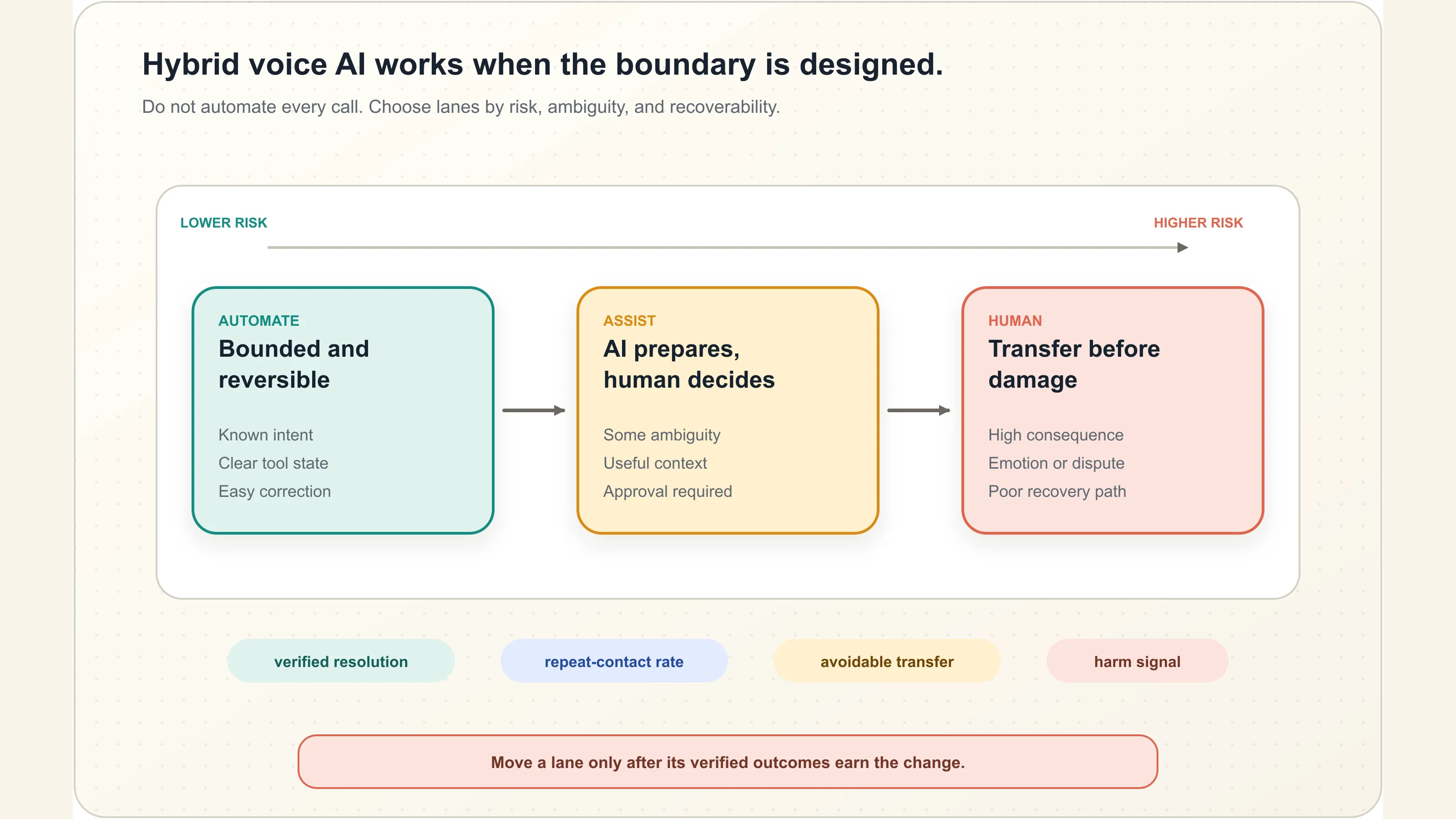
Hybrid covers four distinct product choices:
| Lane | Ownership |
|---|---|
| Fully automated | AI resolves a defined task. |
| AI intake | AI gathers context, then a human decides. |
| Human-owned, AI-assisted | AI supports a human in the background. |
| Human-only | A human owns the entire lane. |
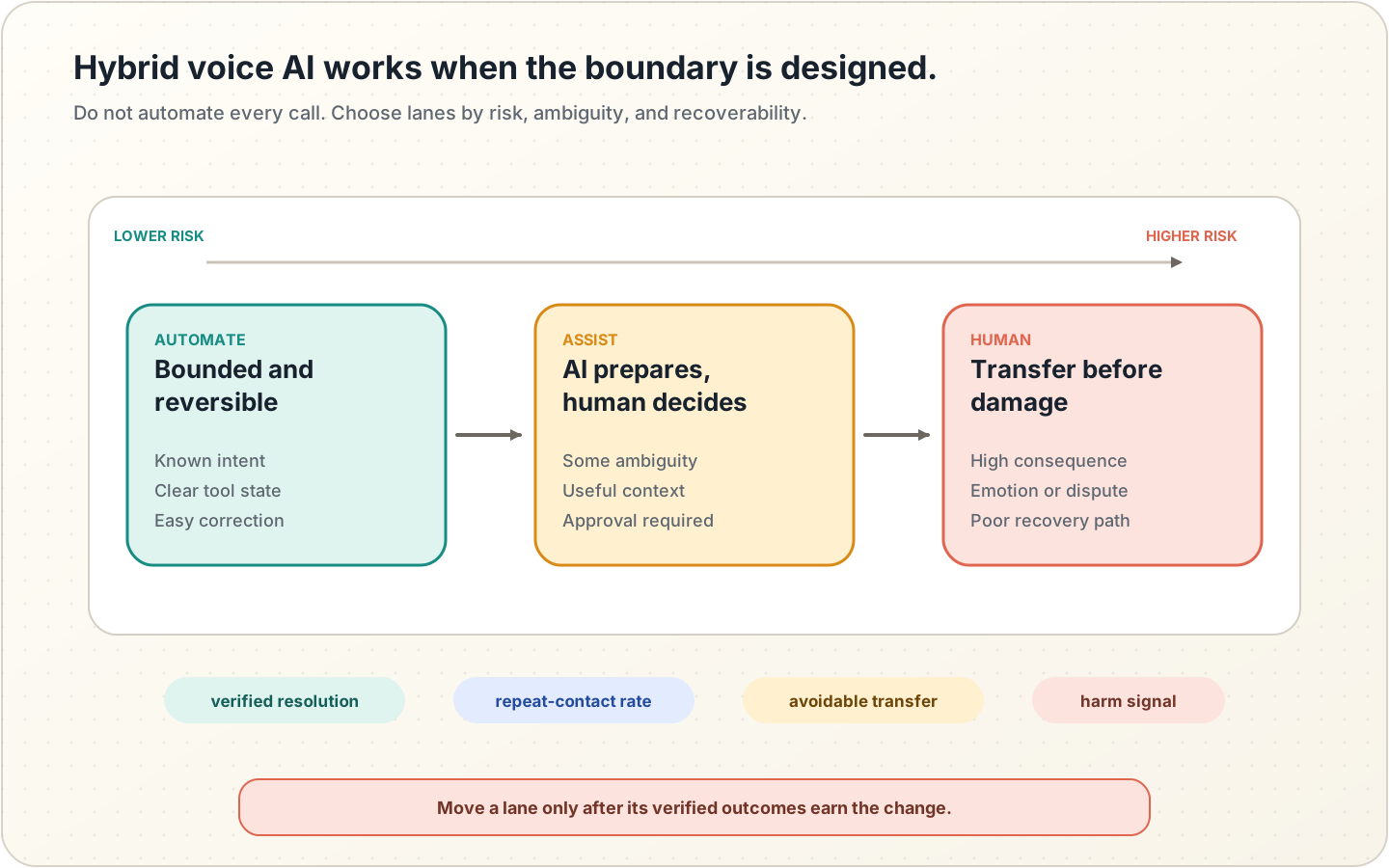
Select the lane from the work, not from a target automation percentage. Each expansion needs an outcome the system can verify, an action boundary it can enforce, and a tested exit. If those pieces are missing, the queue is not ready merely because the model can hold a convincing conversation.
An April 2026 r/realestateainews post argued that human fallback should matter in AI IVR selection. Its aggressive market-adoption figures do not have a transparent source, so Voxeval would not reuse them as facts. The useful signal is narrower: buyers are looking for fallback because pure automation meets edge cases.
Scroll diagram horizontally on smaller screens.
Classify the work before choosing the agent
Start with the top call reasons and describe each as a job with a beginning, an allowed action, and a verifiable end. “What is my delivery status?” has a concrete answer when the agent can read the live order system. “I think your company treated me unfairly” is a broader complaint whose resolution depends on judgment, policy, and the customer’s experience.
Use the same questions for every job. First, is the desired outcome clear and verifiable? Name the specific end state, approved answer, completed action, or accepted handoff that proves success. If the agent’s closing sentence is the only proof, the lane does not have a reliable outcome yet.
Next, what is the credible harm, and does the agent have authoritative data? Write down the wrong-account, financial, safety, legal, or churn scenario, then name the source, access rule, and freshness expectation needed to prevent it. A serious failure should not disappear into an average quality score, and a public FAQ should not stand in for a live customer record.
Finally, what happens under uncertainty, and how much effort does the route create? Define when the agent asks a clarifying question, narrows the task, schedules a callback, transfers, or stops. Count the questions, repeated facts, transfer time, and path to resolution. A long AI intake before an inevitable handoff is not useful automation.
Score the evidence, not the attractiveness of the use case. A frequent call reason may still be a poor automation lane if the system cannot see the current record or safely reverse a mistake. A less frequent task may be a good first lane when its inputs, actions, and outcome are tightly bounded.
Separate ambiguity from risk. A low-risk question can be highly ambiguous and waste the caller’s time. A high-risk task can be structurally clear yet still require a human decision. The lane policy should say which problem it is solving, because adding more clarification helps the first and may do nothing for the second. With that distinction clear, choose the lane.
Lane 1: fully automated
Good candidates have clear intent, authoritative data, bounded actions, a verifiable final state, safe recovery, and low ambiguity after reasonable clarification. Examples may include checking business hours, retrieving a shipment status after authentication, or rescheduling within a fixed policy. Low risk alone is not enough; the workflow also needs a useful automated outcome.
The action boundary should be enforced outside the model. Give the lane only the tools and parameter ranges it needs, validate every write, and compare the final state with the caller’s confirmed intent. A delivery-status lane should not inherit an address-change tool merely because both use the same order service.
Define when the automated lane has spent enough effort. Two failed identity attempts, repeated ambiguity around the same entity, or an unavailable source system may move the call to assisted handling. The exact limits depend on the task, but they should be observable and tested rather than improvised in conversation.
Lane 2: AI intake, human decision
The agent collects and verifies facts, runs safe reads, and prepares the case, while a human owns the consequential choice. This works when intake is repetitive, judgment matters, exceptions are common, and structured context helps the human decide.
The lane fails if the human receives a transcript dump and asks every question again. Design the intake from the human’s next decision. If the specialist needs a verified order ID, a reason code, and the result of a safe eligibility check, collect those fields and stop. Extra questions increase call time and create more facts that can become stale. Structured context should identify the source and verification state of each field, while a short summary explains the caller’s goal in ordinary language.
Measure whether the intake shortened the human path. A high field-completion rate is not valuable when agents ignore the packet or repeat every question. Observe time to first useful human action, avoidable repetition, packet freshness, and final resolution.
Lane 3: human-owned, AI-assisted
Some conversations should begin with a person. AI can still help by retrieving relevant records, suggesting approved knowledge, tracking required steps, drafting notes, flagging missing information, and creating after-call summaries for review.
Keep the human in control of sensitive claims and side effects. Measure whether the assist reduces work without distracting the agent or introducing wrong suggestions.
Assistance should be dismissible and reviewable. The human needs to know which content came from an authoritative record, which was transcribed from the caller, and which was suggested by a model. Pair handle time with outcome quality, accepted or rejected suggestions, and agent feedback.
Lane 4: human-only
Human-only work belongs in an AI strategy. Reasons may include emergency or safety signals, vulnerable-customer policy, a high-value complaint, a legal threat, complex fraud, a language or accessibility need the system has not been tested to support, or an explicit customer request under the service policy. Routing the call away from AI can be the correct automated decision.
The exit must exist before launch
Do not wait for the first angry production call to design the handoff. Define:
- Trigger.
- Destination.
- Hours and queue availability.
- Context packet.
- Caller message.
- Hold or callback behavior.
- Failure path.
- Final owner.
LiveKit’s handoff documentation discusses passing state and context when control moves, while Twilio’s SIP REFER documentation shows the mechanics of blind call transfer and status signaling. Your contact-centre stack needs both capabilities, whether the handoff is between software agents or to a person. The mechanics do not guarantee that a human is available or that context reaches the desktop, so test those separately.
Build the exit as a state machine. handoff_requested, destination_ringing, context_ready, human_connected, and fallback_completed are different states. The caller message must match the state. An agent should not claim that a specialist is available when it has only sent a transfer request.
Test open and closed hours, queue saturation, no answer, rejected transfer, missing context, caller disconnect, and a human who sends the case back. Decide who owns the business record during each state and prevent the AI from continuing durable actions after authority has moved.
The fallback should fit the task. A callback may be acceptable for a routine account question and wrong for an urgent safety signal. A message queue may preserve context but fail a caller who expects immediate cancellation. Document the approved fallback per lane instead of sharing one generic “try again later” response.
A fictional property-management call
Consider an illustrative property-management call that did not happen. A tenant reports water under the kitchen sink. The AI asks whether water is flowing, whether electricity is near the leak, and whether the shutoff valve is reachable. The tenant then says, “It is pouring through the ceiling downstairs.”
That phrase should move the call out of routine maintenance intake. The agent creates an emergency work order, sends the verified address and observed facts, connects the emergency line, and gives the tenant the approved immediate safety instruction. If the system keeps gathering appliance details because the intent was “leak,” it has a script instead of a lane policy.
The transition should be triggered by observed facts, not a broad emotional guess. “Water is pouring through the ceiling” can map to a defined emergency condition in the fictional policy. The trace should retain the phrase, classification, created work order, transferred context, and final route so reviewers can confirm that the rule fired for the right reason.
Release each lane on its own evidence
Microsoft’s agent value blueprints recommend matching use cases with measurable business and quality outcomes. Apply that discipline to voice.
| Lane | Release evidence |
|---|---|
| Full automation | Verified completion, wrong-action rate, repeat contacts, and safe fallback. |
| AI intake | Required fact capture, fact accuracy and provenance, repeat-yourself rate, and human time to first action. |
| Human assist | Suggestion acceptance with review, wrong-suggestion rate, handle time and after-call work, and human trust and override. |
| Human-only routing | Trigger recall, false routing, queue survival, and time to human. |
Do not compare all four on containment because that metric rewards the wrong lane. Use the lane-specific gates above with one shared journey view that follows repeat contacts, caller effort, cost, and critical incidents across all four.
Release a narrow call reason first, not an entire department label. “Reschedule a standard appointment within policy” is testable. “Handle appointments” hides cancellations, clinical questions, insurance exceptions, and accessibility needs under one name. Add adjacent work only when its own evidence passes.
Record the exact model, prompt, tool permissions, policy version, languages, routes, hours, and fallback used for the decision. The lane is a configured product surface. A change to any of those inputs can alter its risk even when the marketing name stays the same.
Monitor lane drift
Call reasons and policies change, attackers learn, and customers discover shortcuts.
NIST’s AI RMF Playbook calls for ongoing monitoring, documenting errors, gathering feedback, and considering error propagation. It is voluntary guidance, not legal advice. The operating lesson is plain: classification at launch is not permanent, so review:
- New escalation clusters.
- Repeat contacts.
- Calls moved between lanes.
- Human overrides.
- Unsupported languages or accessibility needs.
- Critical incidents.
- Business-system changes.
Use these signals as operational tripwires. A rise in repeat contacts, handoff failures, unknown outcomes, critical errors, or unsupported-language calls can pause new traffic or move a workflow to a safer lane. Define the window and owner before launch so the response does not depend on a debate during an incident. When a lane accumulates exceptions, narrow it instead of adding prompt clauses to protect the original scope.
Review real call clusters as well as aggregate rates. A stable average can hide a new customer phrasing or regional route that repeatedly enters the wrong lane. Promote those patterns into the classifier and end-to-end regression suite, then verify that the correction does not damage nearby call reasons.
For assisted and human-owned lanes, measure the repeat-yourself rate. For every lane, use cost per verified resolution so transfers and repeat work stay visible. Voxeval’s voice automation lane worksheet records the call reason, risk, outcome definition, data dependency, action boundary, human exit, evidence, owner, and release decision. The strongest automation program is not the one with the highest containment; it is the one that knows exactly which work the machine should own, what evidence proves success, and how the caller exits when the machine should not continue.
Subscribe to Voxeval for opinionated voice AI buying, testing, and release guidance.
Reference list