Release readiness
Production voice agents need release gates, not just low latency
A vendor-neutral playbook for separating conversation quality from business correctness and turning voice-agent incidents into permanent regression gates.

Write the release decision before results arrive
Define scope, evidence, hard gates, exceptions, rollback, owners, and sign-off in one reusable voice-agent release record.
voice-agent-release-gate-template.md
A fast voice agent can still make the wrong change to an account. It can also skip a required disclosure, call the right tools in the wrong order, promise a result that never reached the system of record, or lose context during a handoff. Low latency makes a conversation feel responsive; it does not establish that the workflow ended correctly.
The practical response is a release gate: a documented rule that connects a proposed version to replayable cases, retained evidence, and an accountable decision. This playbook describes how to build that gate with your own harness, vendor tools, or Voxeval. It treats recent product announcements as evidence about available infrastructure, not proof of an application’s reliability.
Infrastructure is improving; release evidence still matters
The infrastructure story is genuinely useful, provided its source and boundary remain visible.
Vendor announcement (OpenAI, May 7, 2026): OpenAI introduced three models in its Realtime API. The company described GPT‑Realtime‑2 as supporting GPT-5-class reasoning, adjustable reasoning effort, parallel tool calls, and conversational recovery. It described GPT‑Realtime‑Translate as translating speech from more than 70 input languages into 13 output languages, and GPT‑Realtime‑Whisper as streaming transcription. Those are OpenAI’s product descriptions and internal evaluation claims. They do not independently establish translation quality, tool correctness, or policy adherence in another team’s callers, languages, prompts, or workflows.
Vendor announcement (OpenAI, August 28, 2025): OpenAI made its Realtime API generally available and announced remote MCP server support and SIP phone calling, alongside image input and reusable prompts. These capabilities reduce integration work: SIP connects phone endpoints, while MCP exposes tools to a session. They also widen the system under test. A reachable tool can still receive an incorrect argument; a connected call can still produce a prohibited side effect.
Vendor announcement (Twilio, April 22, 2026): Twilio described Conversation Relay updates including Deepgram Flux support for detecting when a speaker finishes, adjustable interruption sensitivity, PCI-compliant workflows, and HIPAA-eligible architectures. Compliance scope matters here: support for a compliant workflow or eligible architecture does not certify an entire customer application. Teams still own configuration, data handling, access controls, disclosures, and their other processors.
Vendor announcement (Twilio, May 6, 2026): Twilio’s SIGNAL 2026 summary repeated the Conversation Relay additions of PCI compliance, HIPAA eligibility, Insights, and Deepgram Flux support for smarter turn detection. It also announced generally available orchestration, memory, and intelligence products. This article relies on the capability descriptions, not the page’s broader market positioning or customer anecdotes.
These announcements do not demonstrate that a particular production workflow is correct. They show that model, media, telephony, and orchestration components are changing. The engineering inference is that easier assembly shifts more release attention toward application-specific evidence: what the caller intended, what the agent said, which tools ran, which policy applied, and what the authoritative system recorded.
Separate conversation quality from business correctness
Do not compress a session into one score. Keep at least four result axes, because one can pass while another fails:
- Conversation: Was the agent understandable, appropriately timed, and able to recover from pauses, overlap, interruption, or correction?
- Workflow: Did it gather required inputs and invoke permitted tools in the expected order with the expected arguments?
- Policy: Did it make required disclosures, avoid forbidden actions, respect authorization, and hand off when policy required?
- Outcome: Does the system of record show the intended state, without duplicate, stale, or partial side effects?
Latency belongs on the conversation axis and on tool traces, not above the other axes. Measure connection setup, first audible response, interruption handling, tool completion, and end-to-end resolution separately. A low median can conceal a harmful tail, and a quick acknowledgement can arrive before the system knows whether an action succeeded.
Build evidence around the workflow’s risk. For a balance inquiry, a mistaken answer may require correction and review. For a transfer, cancellation, prescription, or identity workflow, an unauthorized mutation may justify an immediate block. That severity difference should be written before results arrive so a release owner cannot relax the rule after seeing a near miss. Classify every release rule as Critical or Non-critical before execution.
Did the agent act on the intended account?
Classification. Critical. Evidence to retain. Redacted audio, identity assertions, tool arguments, and the account audit event. Example team-owned rule. Block if the evaluated version mutates an account that the approved fixture does not authorize. Rationale. Wrong-account changes can be difficult to reverse.
Did spoken status match tool status?
Classification. Critical. Evidence to retain. Agent audio, tool response, and a system-of-record snapshot. Example team-owned rule. Block when the agent confirms completion but the authoritative state is failed or pending. Rationale. Fluent language must not substitute for a committed result.
Did the caller receive the required disclosure?
Classification. Critical for this example workflow. Evidence to retain. Audible playback and a timestamped policy assertion. Example team-owned rule. Apply the workflow owner’s approved disclosure rule to every in-scope case. Rationale. The rule comes from the team’s policy and jurisdiction, not a generic benchmark.
Is latency acceptable for this lane?
Classification. Non-critical for this example lane. Evidence to retain. Condition-tagged timing distributions and reviewed calls. Example team-owned rule. Compare with the lane’s approved budget and baseline. Rationale. Devices, networks, languages, and user expectations differ.
These examples are team-specific risk policy, not universal thresholds. A team should document who approved each rule, which workflows and populations it covers, what evidence it requires, and when it expires or must be reviewed.
Turn incidents into permanent regression evals
An incident should produce more than a ticket. Preserve enough structured evidence to reproduce the unsafe decision while protecting callers. Follow lawful collection and consent requirements; minimize or redact sensitive data; restrict access; and apply a retention and deletion policy. If the raw call cannot be retained, create an approved synthetic or transformed fixture that preserves the failure mechanism and document what changed.
Treat traces and fixtures as security-sensitive. Following the OWASP Logging Cheat Sheet on data exclusion and log protection, adopt a written handling policy. Never store access tokens, authentication passwords, encryption keys, database connection strings, or unnecessary sensitive payloads in traces or replay fixtures. Encrypt retained evidence; make logs tamper-evident; and restrict, record, and monitor every access for audit. Our additional engineering boundary is: Replay only in an isolated non-production environment with sanitized fixtures and mocked or idempotent side effects. This is security guidance, not universal legal advice. Involve the team responsible for applicable legal, regulatory, and contractual requirements.
Use this incident record as a starting point:
Caller intent
What to record. The requested end state, including corrections. Example. Cancel one reservation, then keep the replacement.
Workflow
What to record. The versioned lane and policy owner. Example. Reservation cancellation v4.
Audio condition
What to record. Relevant speech, device, network, and noise tags. Example. Mobile codec; user self-correction during overlap.
Expected tool sequence
What to record. Permitted calls, order, arguments, and stop conditions. Example. Authenticate, read both bookings, confirm target, and cancel once.
Observed downstream state
What to record. Authoritative records after the call. Example. Replacement cancelled; original unchanged.
Policy result
What to record. Required, satisfied, or violated assertions. Example. Target confirmation violated.
Failure layer
What to record. The earliest supported layer, with uncertainty noted. Example. Intent and state tracking after correction.
Regression ID
What to record. A stable case ID tied to the incident. Example. cancel-correction-017.
Release rule
What to record. Classification, decision, and evidence required to clear it. Example. Critical: block the affected lane until the fixture passes and the audit state matches.
Then run a five-step incident-to-regression loop:
- Capture the failed production call and downstream state. Align audio, transcript, model events, tool requests and results, policy checks, handoff events, and final business state on one timeline. Do not infer causation from timestamps alone; retain event IDs and parent links where the stack provides them.
- Attribute the failure layer. Test the earliest supported explanation across media transport, speech recognition, turn detection, model reasoning, prompt or policy, tool adapter, business service, and handoff. Record uncertainty rather than forcing one owner when evidence is incomplete.
- Turn the incident into a deterministic eval. Freeze the policy, tool fixtures, expected sequence, and expected final state. Control the replayable inputs. If the model itself is stochastic, run the team-approved repeated-trial protocol and preserve every trial rather than calling one favorable replay deterministic.
- Run it across the release matrix. Test the proposed model, prompt, voice, tool, transport, and policy changes in the affected lane, then add relevant audio and network conditions. Keep unrelated dimensions fixed so the result is interpretable.
- Block or qualify the release with linked evidence. Name the owner, affected scope, failed rule, regression ID, artifacts, exception approver, and expiry. A qualification is a bounded risk acceptance, not a way to relabel a failed critical gate.
Keep the case after the incident closes. Run it for every change that could touch its failure layer, and periodically confirm that its fixture still represents the production policy. Retire it only with a recorded rationale, such as a removed workflow or superseding test, not because it is inconvenient.
An evidence-backed release gate
A release meeting should consume a small decision record rather than a dashboard tour. List candidate versions, in-scope workflows and conditions, rule classifications, result by axis, linked failures, missing evidence, residual risk, decision owner, and exception expiry. Add rollout exposure, monitoring window, stop conditions, last-known-good candidate, rollback owner and procedure, and downstream-state reconciliation. The record should be reproducible from immutable case and configuration identifiers.
Scroll diagram horizontally on smaller screens.
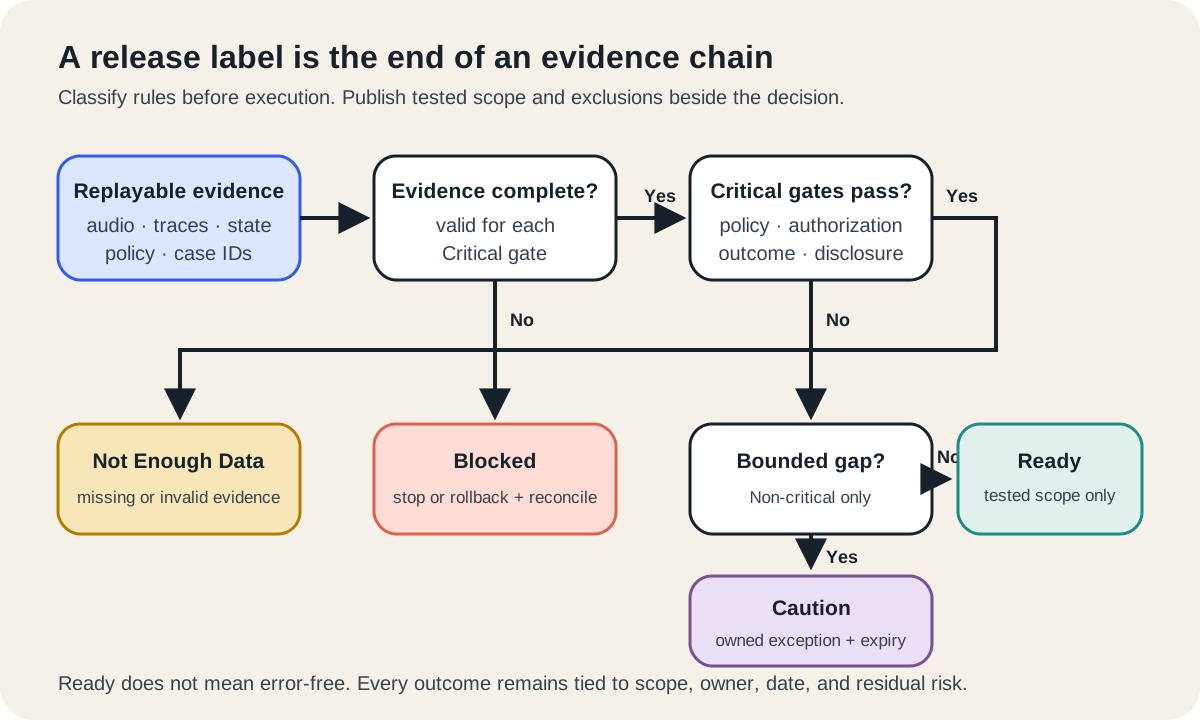
Use Ready, Caution, Blocked, and Not Enough Data as a decision vocabulary:
- Ready means the candidate satisfies the team’s approved rules for the explicitly tested scope.
- Caution means every Critical gate passed and a bounded Non-critical gap has a documented exposure limit, compensating controls, owner, exception approver, retest date, and expiry.
- Blocked means a Critical must-pass gate failed, an unauthorized or falsely reported side effect occurred, or an unaccepted Critical risk remains.
- Not Enough Data means evidence needed to assess a critical gate is missing, invalid, or outside the tested scope.
These labels are not an externally validated accuracy claim, and Ready does not mean error-free. Publish the tested scope and exclusions beside the label. If a language, device, network, workflow branch, or downstream service was not represented, say so. Missing critical evidence should produce Not Enough Data rather than a guessed pass.
A Critical failure or expired exception triggers the documented stop or rollback procedure and reconciliation of effects already produced. Rolling code back does not undo calls, messages, bookings, transfers, or record changes; the rollback owner must compare downstream state with the intended state and repair or escalate discrepancies under the workflow’s approved procedure.
This method works with or without Voxeval. A team can implement it with version control, replay fixtures, trace storage, policy assertions, and CI. Voxeval is intended to operationalize the same method by organizing cases, evidence, release rules, and regression decisions across a changing voice stack. That is restrained product positioning, not a claim of independently measured improvement or externally validated accuracy.
Start with one consequential workflow and one real failure. Define its evidence, encode its rule, replay it against the next candidate, and keep the result. The durable asset is not the latency number; it is the chain from caller intent to release decision.
Reference list