Release readiness
RBI's collection-call curfew: put the 8 AM to 7 PM rule in code
Build server-side time gates, retry limits, consent evidence, and release checks for Indian voice collection agents under RBI recovery-agent rules.
RBI collections release-gate checklist
A practical pre-release checklist covering time gates, retries, identity, language, disputes, escalation, evidence, and shutdown controls.
rbi-collections-release-gate-checklist.md
It is 7:01 PM in Nagpur. The retry queue says “next available.” The dialler says “capacity open.”
The call must not go out.
RBI’s August 2022 circular says the covered regulated entities and their recovery agents must not call borrowers before 8:00 AM or after 7:00 PM for recovery of overdue loans. The circular names banks, certain financial institutions, NBFCs, asset reconstruction companies, and credit information companies. It also says microfinance loans are covered by separate directions.
That is not a prompt instruction. It is a hard outbound-call gate.
Voxeval’s release position is simple: if the model can override the clock, the architecture is wrong. This article shows the controls around that gate, the cases most teams miss, and the evidence risk teams should ask for before an automated collection agent reaches a borrower.
This is an engineering and evaluation guide, not legal advice. Map the rules that apply to your entity, loan product, state, contract, and operating model with counsel.
The clock lives before the dial
Do not let the voice agent start a session, greet the borrower, and then check whether it is allowed to continue. By then you have already called.
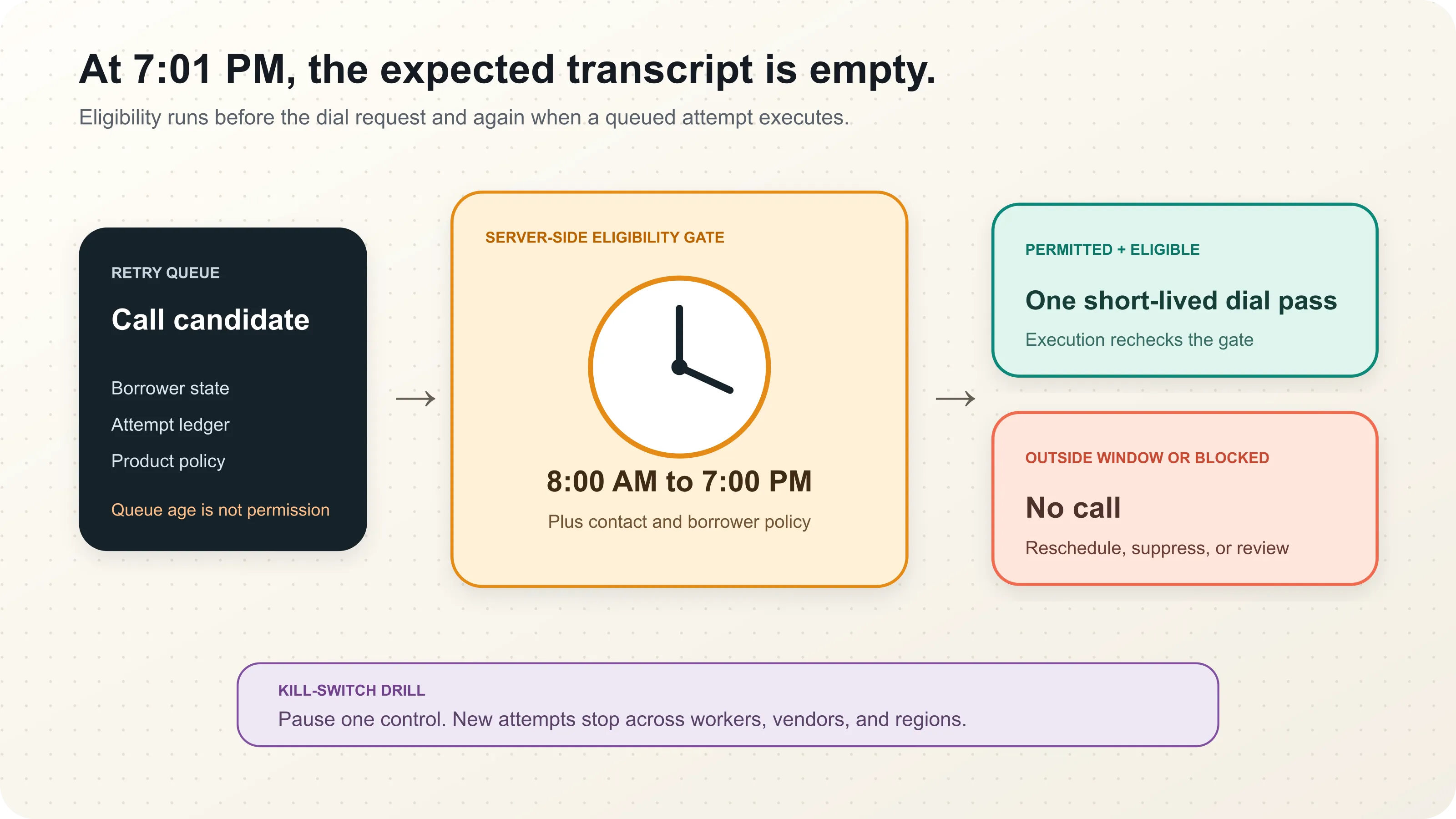
The eligibility service should run before the dial request. It checks:
-
the borrower’s applicable local time;
-
a server-synced clock, not a campaign manager’s laptop;
-
entity and product policy;
-
current consent, suppression, dispute, vulnerability, and cease-contact states;
-
contact attempts across every channel and vendor, not just this one bot;
-
whether enough time remains to complete a reasonable interaction before the window closes.
Then it returns a signed, short-lived permission for one call attempt. No permission, no dial.

6:59 PM is not a clever loophole
A call that begins at 6:59 and runs for 18 minutes may create a bad borrower experience even if someone argues over the literal start time. Set an internal stop-before-close buffer with legal and compliance. At the buffer, new calls stop. Active conversations follow a reviewed wrap-up rule.
The agent should not rush a borrower into payment because the window is closing. Nor should it continue a long collection script after the operating policy says to end.
A safe wrap might be: “Our calling window is ending, so I will stop here. You can use the official payment channels in your message, or we can contact you during permitted hours.”
Exact wording needs your review. The control needs code.
Time zones and travelling borrowers
India has one official time zone, which removes one common source of mistakes. The borrower may still be travelling abroad, the phone number may be used by a family member elsewhere, or a campaign may mix domestic and international contacts.
Pick a documented policy for the applicable local time and encode the most restrictive reasonable result when location is uncertain. Do not infer precise location from a mobile number and call it truth.
Also test clock drift, daylight-saving changes for overseas cases, deployment-region time, leap-day schedules, and a queue item created before the window but executed after it.
Queues are where curfews go to die.
The execution worker must recheck eligibility at the moment of dial. A permission created at 6:45 should expire. A retry after a carrier error gets a fresh decision.
Frequency can become harassment long before the curfew
The RBI circular does more than set hours. It says regulated entities must not intimidate or harass, intrude on the privacy of a borrower’s family, referees, or friends, send inappropriate messages, make threatening or anonymous calls, persistently call, or make false and misleading representations.
So “we only call between 8 and 7” is nowhere near enough.
Build a contact ledger shared across the regulated entity and every recovery vendor. It needs attempted calls, connected calls, messages, human-agent contacts, outcomes, promises to pay, disputes, wrong-party reports, and suppression states.
Then set policy limits.
-
A single carrier error may allow a retry after a cooling period.
-
Four unanswered calls from two vendors should not look like two separate campaigns.
-
Wrong number? Stop collection content immediately and suppress pending identity review.
-
The borrower says the debt is disputed. Route it. Do not keep pressing the same script.
-
Vulnerability or bereavement?
Human review.
Identity before disclosure
Imagine a fictional borrower named Meera. Her brother answers the shared household phone. The agent says, “This is about Meera’s overdue personal loan.” Damage done.
Your opening needs to reveal as little as possible until the correct person is verified under the regulated entity’s approved method. Avoid putting debt status in voicemail. Avoid asking a family member to relay an embarrassing message. And do not treat caller ID possession as identity proof.
Test the awkward replies:
-
“I am her husband, tell me.”
-
“She is in hospital.”
-
“Who are you and why do you keep calling?”
-
A child answers.
-
The customer refuses authentication but asks whether the call is genuine.
The bot needs a safe exit and an official verification route. It should never improvise pressure.
Collections language is a policy surface
Prompt reviews tend to focus on tone. Release tests need to inspect claims.
Can the agent invent a legal consequence? Suggest that police will visit? Promise a settlement not returned by the approved tool? Hide a fee? Say “last chance” when it is not? Threaten a credit-score effect beyond approved wording?
Treat every material claim as one of three things:
- Returned by a controlled system for this account.
- Approved static language with versioning.
- Not allowed.
The model may connect approved facts in natural language. It cannot create collection powers.
For Hindi, Marathi, Bengali, Tamil, and other caller languages, review the actual spoken output. A translation can become harsher than the English policy sentence. Record evaluators’ reasons and include local-language compliance reviewers.
Show the audit trail without hoarding the call
A release-ready system should prove:
- why the borrower was eligible for contact at that instant;
- which policy and script versions ran;
- authentication state before any disclosure;
- which offers or amounts came from approved systems;
- interruptions, transfer requests, and suppression events;
- call outcome and resulting account state;
- who approved any exception.
That does not mean keeping every raw recording forever. Set retention by purpose and applicable policy. Restrict access. Redact sensitive fields from general logs. Record hashes or references where they give enough evidence without copying the secret.
Pull the plug from one place
Campaign pause cannot depend on editing a prompt and waiting for caches to clear.
Give compliance and operations a tested kill switch at the dial layer. It should stop new attempts across models, vendors, queues, and regions. Show the current state in one place. Alert when a worker tries to dial while disabled.
Run the drill before launch:
- Put fictional contacts into a staging campaign.
- Start the dial queue inside the allowed test window.
- Trigger the kill switch while calls are queued.
- Confirm no new call begins.
- Inspect what active calls do.
- Try a delayed retry from another worker.
If the retry escapes, the switch is theatre.
The gate for Friday afternoon
Use Voxeval’s RBI collections release-gate checklist with engineering, operations, compliance, and the regulated entity’s accountable owner. It covers the clock, contact ledger, identity, claims, language, disputes, evidence, handoff, and shutdown.
Schedule one test for 7:01 PM.
The expected transcript is empty.
Reference list