Evaluation
The repeat-yourself rate: the voice AI handoff metric buyers should demand
Measure whether AI-to-human voice handoffs preserve facts, attempted actions, caller intent, and momentum instead of forcing customers to restart in production.
Handoff continuity scorecard
A CSV scorecard for measuring context completeness, repeat-yourself rate, transfer outcome, human recovery time, and final resolution.
handoff-continuity-scorecard.csv
“How can I help you today?” The caller has already spent six minutes explaining exactly that.
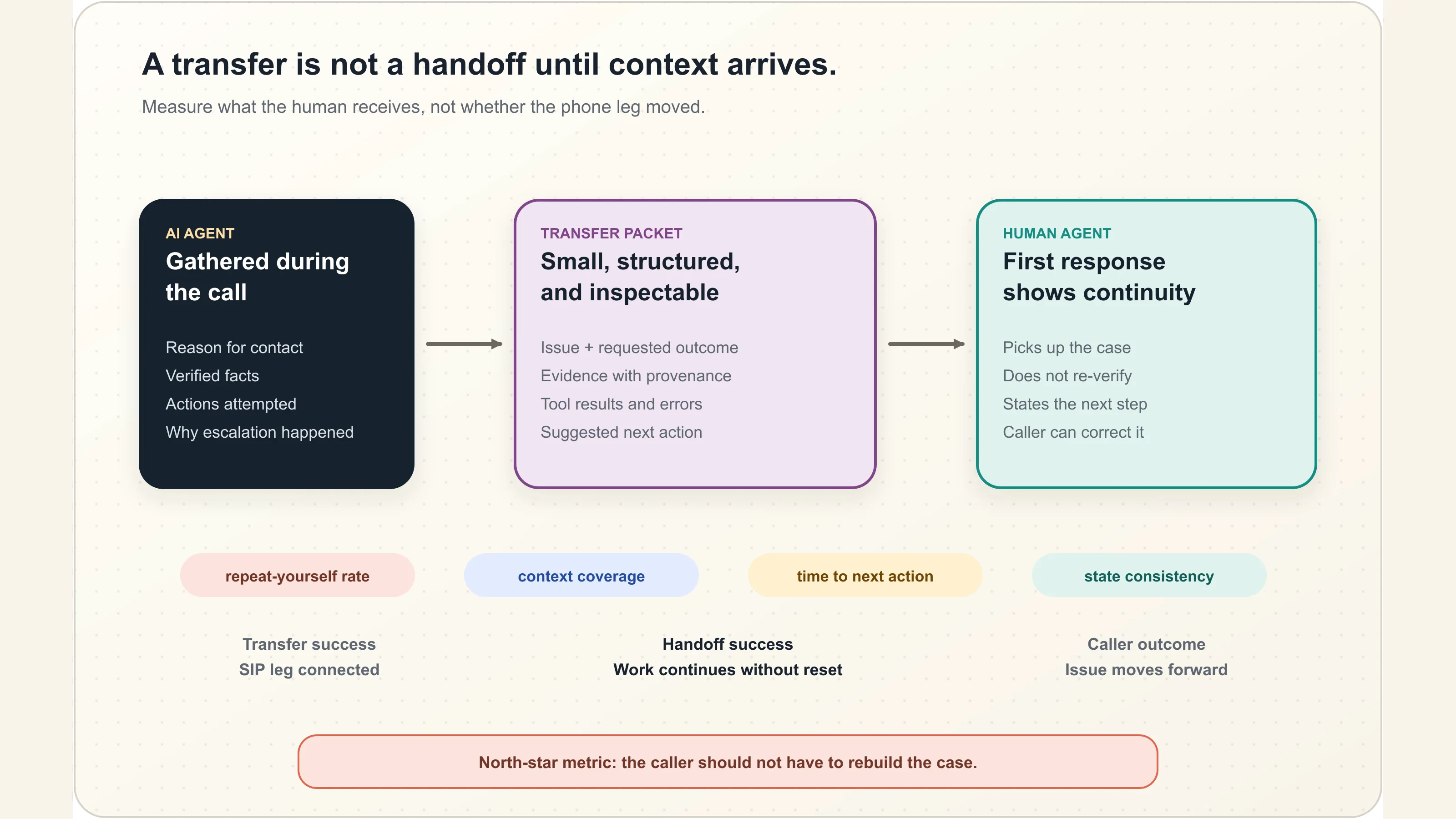
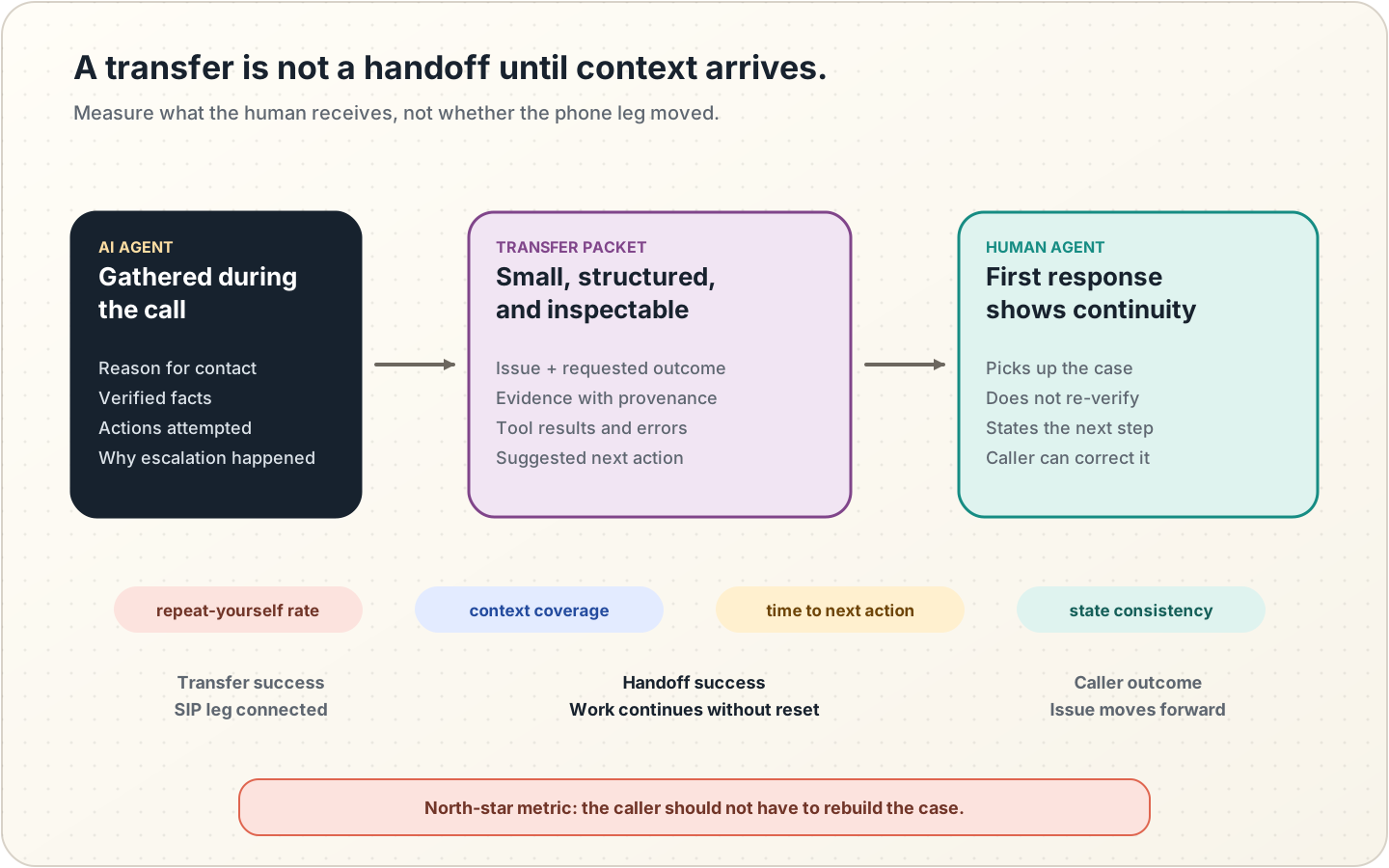
If your voice AI transfers the call and the human starts from zero, the phone leg moved but the service experience still broke.
For CX leaders, contact-centre operators, and builders buying or shipping hybrid voice AI, a useful definition of handoff success must follow the caller all the way to resolution. The repeat-yourself metric and scorecard below do exactly that.
Buyers keep measuring the wrong event
Dashboards love transfer_started because it is crisp, countable, and usually green. The caller cares about something else: did the next person know why I called?
In a June 2026 r/AI_Customer_Support thread, commenters repeatedly raised context carryover and voice pacing as buying criteria. Another customer-experience discussion focused on bot-first journeys, repeat effort, and the way poor automation can hand an already annoyed customer to a human.
These are practitioner discussions, not controlled studies, and some replies are promotional. Their value is the recurring question of why the customer had to say it again.
Scroll diagram horizontally on smaller screens.
Define the repeat-yourself rate
Start with a simple ratio. The numerator is escalated calls where the human asks for information the AI already collected and could lawfully pass. The denominator is escalated calls where that information was relevant to the human’s next action.
That denominator matters. A human re-verifying identity under policy is not the same as asking the caller to retell the whole problem because the transcript never loaded.
Count the human’s request, not only the caller’s complaint. A customer may politely answer again even though the handoff failed.
Slice the rate by information type: reason for contact, verified identity state, critical entities such as order number, date, address, amount, or product, steps already tried, tool results, caller preference, and escalation reason.
Now the metric can tell you what failed. “Repeat rate: 18%” is a complaint. “Verified order number missing on 31% of billing handoffs from the returns lane” is a work item.
Define the observation window before collecting the number. The repeat can happen in the first human sentence, five minutes into the call, or after the case moves to a second specialist. For most handoff diagnostics, Voxeval records requests from the moment the human accepts the call until the human has enough verified context to take the first useful action. A broader journey metric can follow the customer across later transfers and repeat contacts, but it should not be mixed into the same denominator.
The request also needs a reason code. A human may repeat a question because policy requires independent verification, the caller corrected the value during transfer, the context packet was late, the desktop hid the field, or the field never existed. Label those separately. The metric is meant to find avoidable repetition, not pressure agents to skip a required control.
Start with a calibrated sample of recorded or observed handoffs. Give reviewers the AI trace, the context packet, what the human could see, and the resulting conversation. Ask them to mark the repeated field, whether it was available and relevant, and whether re-verification was required. Once the categories are stable, automate the obvious cases and continue sampling the ambiguous ones.
Track what happens after hello
Pair the repeat-yourself rate with four companion measures for every hybrid lane.
Context usability separates available data from usable data. Could the human act from the packet, or did they have to read the transcript and reconstruct the call? A technically complete payload that arrives as an unstructured wall of text belongs in the second group.
Time to first useful human action starts when the human answers and stops when they do something that advances the caller’s goal. A greeting, apology, or minute spent searching for the case does not stop the clock.
Transfer survival records whether the caller reached the intended human, queue, or callback path. Include calls abandoned during hold and transfers routed into a closed queue so a successful SIP event cannot hide a failed journey.
Final resolution checks whether the business outcome completed and matched what the caller requested. Keep unknown outcomes visible instead of folding them into passes or failures without evidence.
Read the measures together. A fast transfer can still force a restart, a rich packet can remain invisible in the desktop, and a friendly human can still be unable to complete the action.
Segment the results by sending workflow, destination queue, transfer type, language, and desktop version. A blended rate can hide a clean support-to-billing path and a broken returns-to-carrier path. Keep the number of eligible handoffs beside every percentage, since low-volume specialist queues can swing sharply from one week to the next.
Pair the operational metrics with a short qualitative review. Listen for caller reactions such as “I already told the bot” and for human workarounds such as apologizing before opening another system. Those moments explain why the number moved and often reveal a context field that the schema never captured.
A handoff has two planes
A handoff has two planes: the media plane moves the live call, while the context plane moves the meaning the next person needs. SIP can transfer a call successfully while the human desktop receives nothing useful. Twilio’s current SIP interface documentation supports SIP REFER for moving calls and UUI or custom headers for contextual information. That does not decide what your application should send, how fresh it is, or whether the receiving system displays it.
Framework-level handoffs have the same split. LiveKit’s agent handoff guidance covers passing state, preserving context, and summarizing it when control moves between agents. Transport provides the connection, but continuity determines whether the handoff works for the caller.
Treat the two planes as a joined transaction. Give the media transfer and context packet the same handoff_id, record when each became available, and keep the destination that accepted them. This lets you distinguish “call arrived before context,” “context reached the wrong queue,” and “both arrived but the desktop did not render the packet.” All three feel the same to the caller, but each has a different owner.
Freshness matters as much as completeness. A static summary generated at transfer_requested can become stale during a long queue wait, so keep typed facts connected to current workflow state and surface any corrections that arrive before the human answers. Generate the human-readable summary as close as practical to the receiving moment.
The packet a human can actually use
Do not send a raw transcript and call the job done. At the point of transfer, create a compact, typed packet while keeping the raw evidence available for review.
Every fact needs provenance. Did it come from caller audio, CRM data, a model inference, or a failed tool response? A polished summary can quietly turn a guess into a fact. Use a small contract between the voice system and the receiving desktop that marks fields as verified, claimed, inferred, or unknown. Keep attempted actions separate from completed actions. Include the escalation trigger, the last confirmed caller request, and the next safe action, but omit speculative advice that the human may mistake for policy.
The contract should also define what happens when a required field is missing or too large. A truncated transcript hidden behind an ellipsis is not a fallback. The receiving system may show a clear “context unavailable” state, route the handoff to a prepared queue, or let the AI explain that the human will need to confirm specific details. Honest degradation is better than a plausible summary with silent gaps.
For example:
{
  "conversation_id": "conv_...",
  "reason": "delivery_address_change",
  "verified_facts": [
    {
      "name": "order_id",
      "value": "A10482",
      "source": "caller_audio",
      "confirmed": true
    }
  ],
  "attempted_actions": [
    {
      "tool": "update_delivery_address",
      "status": "blocked",
      "reason": "order_already_packed"
    }
  ],
  "escalation_reason": "policy_exception_required",
  "caller_request": "hold at local depot",
  "next_best_action": "check carrier exception console"
}
Do not summarize away the correction
The following call is fictional and did not happen. A caller says an appliance was delivered to “14 King Street,” then corrects it to “40 King Street.” The agent cannot change the shipment and transfers to a human.
The summary says:
Customer reports a delivery issue at 14 King Street.
The transcript contains the correction, but the human sees the summary first and acts on the old address.
A continuity test should fail the handoff before the human ever answers. The packet must contain the current value, the superseded value, and the correction event. The human should see “40 King Street, caller corrected from 14,” because shorter is not always safer.
Test the human desktop, not only the API
Your context service returned 200, but was the packet visible?
Run the handoff through the actual queue and desktop. Check:
- The call reaches the right queue.
- The context arrives before or with the call.
- The receiving agent can read it without opening five panels.
- Stale values are marked or removed.
- Sensitive fields follow the correct access policy.
- The human can open the supporting evidence.
- The caller hears an honest transfer message.
- A failed or closed queue has a safe fallback.
The final check matters because a perfect context packet sent to an unstaffed queue is still a failed outcome. Test timing as well as presence: the packet may arrive after the agent has already asked the caller to start again. Record context-ready time, human-answer time, first-view time, and first-useful-action time. For warm transfers, verify what the human receives during the private consultation and what updates after all parties join. For cold transfers, confirm which system remains responsible when the original agent session ends.
Desktop usability deserves direct observation. A field can be technically present yet buried below a transcript, clipped at a narrow viewport, or shown without a label that distinguishes verified data from model summary. Watch trained agents use the screen under normal queue pressure. Count extra clicks, searches, and moments where they leave the handoff view to reconstruct the case.
During a buying test, ask the vendor to run three live failure scenarios through that same queue and desktop: interrupt the AI with a correction immediately before a cross-system transfer, make the destination queue unavailable, and delete one required field. For each scenario, inspect what the human sees before answering, where provenance and confidence appear, how fallback works, and what happens through final resolution. Do not accept a slide that says “full context handoff.”
Ask who owns failures after purchase. Media routing may sit with the telephony vendor, context generation with the agent platform, and display with the contact-centre system. Your contract should still produce one trace and one incident path. A buyer should not have to arbitrate three dashboards while customers repeat themselves.
Set acceptance criteria with actual workflows. For a delivery exception, the receiving agent may need the order, the carrier response, the caller’s preferred remedy, and the failed action. For an account closure, policy may require the human to repeat identity checks while the reason and prior retention offer should carry forward. “All context” is neither testable nor desirable; the smallest sufficient packet is.
Own the seam
The bot team is often measured on containment, the contact-centre team on handle time, and the integration team on shipped events. Those boundaries can leave nobody responsible for the five seconds where the caller changes systems, so give that seam one product owner and one release gate.
If the handoff exists because the call crossed a risk boundary, define that boundary with automation lanes, then score the whole path with conversation-level QA rather than a transfer event in isolation. The Voxeval handoff continuity scorecard tracks the media transfer, packet fields, repeat requests, time to action, fallback, and verified outcome for recorded test calls and human-agent observations.
A customer should not pay twice for your automation: once with their time and again by repeating the story.
Subscribe to Voxeval for practical voice AI evaluation scorecards and field notes.
Reference list